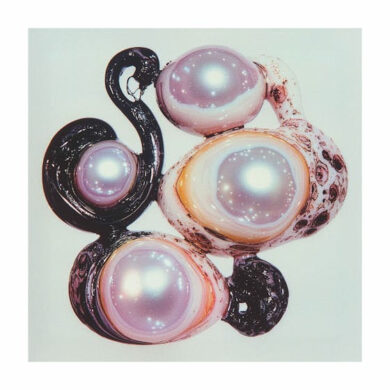
To wander means to give up the idea of a destination. To move through sound without immediately searching for a form, allowing encounters, detours and resonances to suggest the way. It is from this gesture that In Vago Spirito takes shape, the new album by Ludovica Manzo, out on 15th October via Kohlaas.
A work that moves between contemporary vocal music, electroacoustic music and experimental electronics, where the voice becomes sound matter and the boundary between improvisation and composition dissolves. The album inhabits a territory that may evoke the sonic worlds of Wendy Carlos, Björk and Maja S. K. Ratkje, transforming the voice into a living, malleable and constantly evolving material.
Each track takes shape from vocal and sonic improvisations developed over time, following a process that seeks to interfere as little as possible with the original material. Rather than constructing an idea, Ludovica Manzo observes sound as it emerges, preserving the nature of its first appearance. The main vocal lines are also first takes, kept precisely because they are free from expectations and predetermined intentions.
As this continuous wandering unfolds, words gradually lose their importance. Syllables emerge spontaneously, guided solely by their sound and by their relationship with the moment in which they are uttered. The voice thus becomes an instrument among instruments, intertwining with electronics and the other compositional elements. The only exception is Inn’Aria, built around words with recognisable meanings but chosen above all for their phonetic qualities, in an attempt to evoke the suspended fascination of ancient languages, only partially comprehensible and, for this very reason, capable of suggesting far more than they explicitly convey.
From these intuitions emerges a long process of production and sonic construction, in search of a balance between the freedom of the initial gesture and a form capable of preserving its energy. The numerous layers of vocals further expand this exploration, transforming the individual voice into a choral organism in which subtle timbral ripples and slight shifts in intonation become an integral part of the soundscape. What emerges is the sensation of a collective presence, of a shared movement guided by a single breath.
In Vago Spirito marks a new stage in the path Ludovica Manzo has pursued for more than twenty years around the dialogue between free improvisation and composition, developed through her work with O-Janà, Inland Images, Animal Mother, and later through the solo project Serpentine, released by Diacronie in 2025. Alongside her, Ruggero Fornari, guitarist, composer and producer, contributes to the construction of the album’s sonic universe, bringing acoustic instruments, modular synthesizers and electronic processing into dialogue.
In Vago Spirito opens up a space for listening. A place where sound precedes language and meaning remains deliberately blurred, allowing the resonances, imperfections and breath of the voice to indicate the direction. An album that invites us to linger in uncertainty, following sound without the need to translate it.
CREDITS
Ludovica Manzo: voice, electronic, synth, ukulele
Ruggero Fornari: guitars, electronic
All music and lyrics by Ludovica Manzo “Tūn” by Ludovica Manzo and Ruggero Fornari
Tracks 2, 3, 4, 7, 8 produced by Ludovica Manzo and Ruggero Fornari
All other tracks produced by Ludovica Manzo
Mix e master: Andrea Trona
Cover art: Blumquist
Label: Kohlhaas


Komentarai